


a tribute to robert williams:

Originally posted 3/1/2013 by Mat Gleason, permission to share excerpt granted by author.
On Saturday, March 2, 2013, artist Robert Williams turned 70 years old. His significant contribution to fine art was rediscovering classical figurative
painting techniques and reintroducing them to an American audience with a revolutionary twist - it came to be called "Low-Brow", but in his earliest major
paintings in the late 1960s they were called "Psychedelic" and much worse. Derided and degraded for decades by the contemporary art establishment, he rose
to the top with a commitment to using the visual vocabulary of the cartoon as a realistic painting, rendered with precision and unlimited imagination.
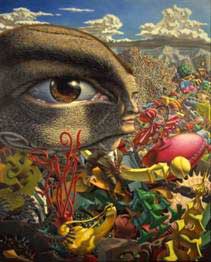
I wrote this article in 2009 for an issue of Juxtapoz Magazine devoted exclusively to him and his art. All images appearing here are copyright by the artist
and used with his permission and that of the Tony Shafrazzi Gallery.
artist of the decade and beyond:
There are many great reasons that Robert Williams is the most historically significant artist of the past 40 years and is the living artist most likely to
establish and maintain a status near the top of the canon of art history centuries from now. First and foremost, history has shown that oil paintings,
specifically ones painted on stretched canvas, last a long time. We know that because quite a few of them are still around. Art historians will tell you
why they are singular masterpieces, but an oft-ignored fact is that they were durable objects stored in castles and churches that did not burn down.
Films rot, video demagnetizes, photographs fade, graffiti gets painted over and the buildings it is on fall over, paper turns to powder - even if your comic
book collection is sealed in plastic bags. Anything electronic lasting a thousand years might require its circuits getting gutted and updated every three
decades, let alone requiring centuries of consistent civilization and a well-governed mercantile system to deliver the juice.
 Paintings no larger than a person have shown that they can be hidden in an attic for a few hundred years with or without a nearby power plant. As great as
Hitchcock, Spielberg and Tarantino are, the historical jury is out on whether or not the millions and millions of DVDs will not soon go the way of the VHS
tape. How many operas do we all watch? How many films of the 1920s are we well versed in discussing? You think you are busy? Movies are so culturally
specific that people will lose interest in today's masterpieces decades or centuries from now, there will be no preservation, long-term. But a painting
in the corner can last a hundred lifetimes and still be experienced. If a flood or fire is coming, there will not be time to lift the heavy bronze sculpture,
but you can easily grab the painting.
Paintings no larger than a person have shown that they can be hidden in an attic for a few hundred years with or without a nearby power plant. As great as
Hitchcock, Spielberg and Tarantino are, the historical jury is out on whether or not the millions and millions of DVDs will not soon go the way of the VHS
tape. How many operas do we all watch? How many films of the 1920s are we well versed in discussing? You think you are busy? Movies are so culturally
specific that people will lose interest in today's masterpieces decades or centuries from now, there will be no preservation, long-term. But a painting
in the corner can last a hundred lifetimes and still be experienced. If a flood or fire is coming, there will not be time to lift the heavy bronze sculpture,
but you can easily grab the painting.
Of all the paintings being produced in the past two hundred years, you can write off almost all of any but the best abstract paintings - while many people
look and think "hey I could do that", it is inevitable that over the course of the next thousand years, looking at a splash or a scribble with less significance
than ever will at some point inspire someone to think "hey, I could improve that!" Yesterday's meditation on formal elements is tomorrow's background for
an illustration of some space invasion fantasy we could never comprehend ahead of time.
And such is the fate not only of abstraction, but of all mediocre painting. No matter how deep the rationalizations go, you only need enter a college art
department one day after finals to see what happens to the work on canvas that was left behind after being whipped out in training exercises or created
just for completions of assignments: They are quickly pilfered and gessoed over. But when a canvas pulsates with talent and accomplishment, it simply makes
it to the wall in someone's apartment, awaiting the judgment of the next decade or century.
 We live in a time when it is fashionable to make art that utilizes mechanical processes of reproduction, to the point of glutting out so much product into
the world. But all of this quick fine art is as easy to dispose of as it is to manufacture. The human animal has shown over 6,000 years of recorded civilization
to treasure the hand-made, the individually conceived and created and the well-crafted. In other words, I give your Shepard Fairey print 65 years, tops.
We live in a time when it is fashionable to make art that utilizes mechanical processes of reproduction, to the point of glutting out so much product into
the world. But all of this quick fine art is as easy to dispose of as it is to manufacture. The human animal has shown over 6,000 years of recorded civilization
to treasure the hand-made, the individually conceived and created and the well-crafted. In other words, I give your Shepard Fairey print 65 years, tops.
Paintings have been proven to chemically survive the elements, they are light and portable and do survive for centuries when undisturbed. The most masterfully
hand-painted of them are revered enough as an example of what the species can accomplish that they do not get destroyed or painted over. Of all the art being
produced today, Robert Williams is making exactly the type of art that will be around to be considered for a spot in a museum setting a thousand years from now.
Robert Williams may be the lone voice speaking for us then, perhaps a final fragment of America, or a last illustration of the twentieth century's turn of the
millennium into the twenty-first. It will be a time when you and I will be considered perhaps, savages. Don't worry, we'll both be dead and not have to explain
ourselves or our world-view to anyone. The paintings of Robert Williams will speak loud and clear on behalf of you and I and of the mad times in which we wallowed.
~Swapmeet Sally, 2004
READ THE FULL ARTICLE by Mat Gleason's at Huffington Post by clicking HERE
Follow Mat Gleason on Twitter: twitter.com/CoagulaMagazine